

A Smart Road Map to Happiness
A Book Review by Vijay Gupta

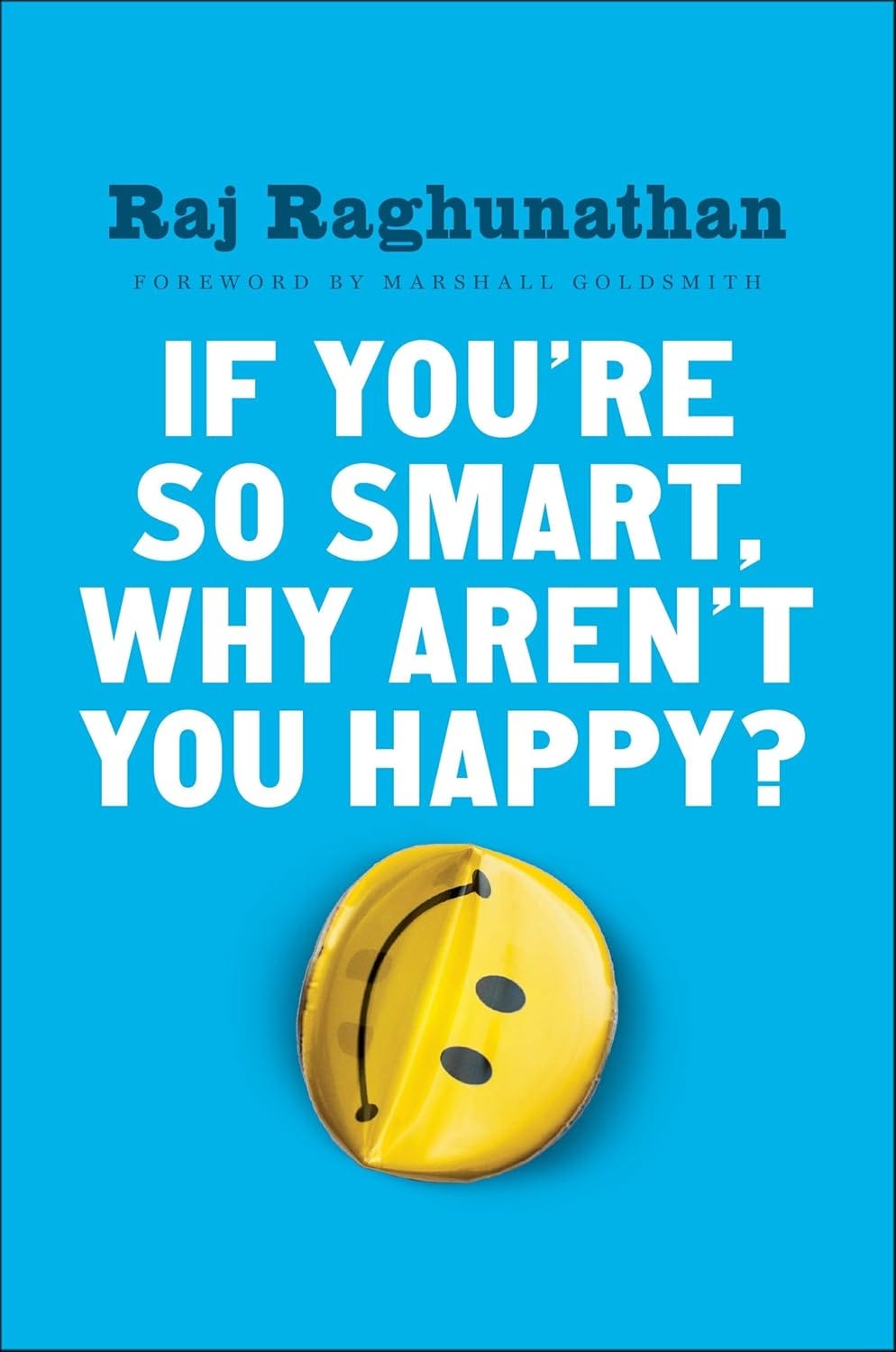
Vijay Gupta, one of socread's prolific members from Westside Stories (our US/Canada reading group) introduced us to Raj Raghunathan's If You're So Smart, Why Aren't You Happy in session #14.

The book featured in Westside Stories sessions #16, #18, and #20 as well where, drawing inspiration from Vijay ji, other readers picked it up.

What follows is a crisp (i.e. clear, concise, and impactful) review of the book by Vijay ji, an apt invitation to explore it further.

The original review is linked below in PDF format. The version published below is verbatim with the exception of some paragraph breaks and pull quotes added to help the casual readers. 
What does it take to lead a happy and fulfilling life?
In If You’re So Smart, Why Aren’t You Happy?, Raj Raghunathan, a professor of marketing, tackles this age-old question with some fresh insights into human nature.
Noticing that many of his classmates seemed unhappy despite great success in their careers, he set out to uncover why “smart and successful” (S-and-S) individuals often struggle to find happiness. The result is a book that blends ancient wisdom with modern research and offers practical, evidence-based advice to help readers achieve lasting happiness.
The book’s core premise is that although we all want happiness, and we all (or at least the S-and-S) have the wherewithal to lead a happy life, we compromise that goal by indulging in seven "sins of happiness." The author analyzes each of these seven sins, and suggests alternatives to the sins, called the “habits of the happy.” The book is divided into seven chapters, one chapter for each sin and its corresponding habit.
The first sin is that we often devalue or deprioritize happiness in our lives, perhaps unwittingly. For example, we may choose a job that pays more even though it makes us miserable compared to another job that makes us happy.
Or when choosing a free gift at a party, we often pick a gift of higher economic value rather than a gift that makes us happy. The author's advice: when the opportunity arises, prioritize happiness.
Prioritize, but don't pursue happiness.
However, there is an important caveat: prioritize, but don't pursue happiness. Why? Because when we pursue, or chase, happiness, we are likely to compare how we feel with how we would ideally like to feel. This comparison with an unrealistic expectation will often lead to disappointment and unhappiness.
A good analogy for this approach to happiness is how we prioritize sleep but don’t pursue or chase it.
The next sin is the pursuit of superiority, which is often seen as essential for success in the highly competitive world of the S-and-S. Although being in a superior position can often make one happier, the “pursuit of superiority” lowers happiness.
Why? Because superiority is subjective and hard to define or measure, the pursuit of superiority usually turns into an unending pursuit of status and materialistic rewards. This, in turn, leads to discontent with one’s status, a tendency to compare oneself with others, a decline in the quality of relationships, and much unhappiness.
What to do instead? Replace the dual sin of the pursuit of superiority and materialism with a dual habit of pursuing flow and expressing gratitude. It is easy to see how expressing gratitude can boost happiness by strengthening social bonds, but what is flow?
Flow is a state of mind where one is so absorbed in a favorite activity that time passes unnoticed. Other indicators of being in a flow include a lack of self-consciousness, being in the moment, and being adequately (but not overly) challenged with regards to one’s skills.
Embracing flow happily eliminates the need to pursue superiority.
An architect absorbed in designing the details of a house and a poet lost in composing his favorite poem are good examples of people in flow. Embracing flow happily eliminates the need to pursue superiority.
Another important sin is a passionate or obsessive pursuit of a goal accompanied by a strong emotional attachment to the outcome. Such a mindset, however, is bound to cause a lot of disappointment and unhappiness if the goal is not achieved.
The alternative: pursue your goal dispassionately. Or to put it in the language of an ancient advice (from the Bhagavad Gita): do your action without being attached to, or preoccupied with, the result.
A common objection to this advice is that if we don't care enough about the result, what would motivate us to work hard for it? Raghunathan's nuanced response is that we should have a preference for the desired outcome before it occurs, but be nonjudgmental about it after it occurs.
Why? Because, first, the result is not under our control anyway. Second, happiness often results more from the action (or journey) itself than from the result (or destination). Third, studies show that most people's view of past failures or negative events in life becomes much less negative over time. Finally, people often misjudge or overestimate both the goodness and badness of an outcome.
Happiness often results more from the journey than from the destination.
As an example, suppose you work hard to get your dream job at your favorite company, but fail to get it. However, you enjoyed the effort, and in the process, you learned a great deal about the company, its products, and the interview process. This experience will likely help you get a similar job at another company. Moreover, it is quite possible that you overestimated your dream job, and the other job may turn out to be just as good.
Some other sins of happiness include being needy, being overly controlling, and distrusting others. The author's advice is to replace these sins with the corresponding habits of being generous, gaining internal control, and exercising "smart trust."
Studies show that generosity not only boosts happiness, but, perhaps surprisingly, also makes you more successful in the business world. Internal control (over one’s emotions and feelings) eliminates the problematic need for external control (over people and outcomes).
And being able to trust others makes your daily life much smoother and happier. But what is smart trust? It is an approach to trusting others that minimizes the risk of your trust being violated as well as the pain when you are cheated.
Trade your sins of happiness for habits that will truly enhance the quality of your life.
These habits of the happy increase both the occasional, or episodic, happiness and the base level of ongoing, or steady state, happiness. Prioritizing happiness, being generous, and trusting others lead to many occasions of joy and happiness, while pursuing flow, gaining internal control, and being grateful raise the base level of ongoing happiness.
Moreover, some of these habits also help reduce unhappiness. For example, shunning external control and being nonjudgmental about the outcome of your efforts eliminate major sources of unhappiness.
An important feature of this book is that the author explains both the logical reasons and the empirical evidence in support of his tips and advice. For each habit of the happy, there is also a “happiness exercise” to help the readers develop and nurture their new habit.
The author also teaches a very popular online course on Coursera called “A Life of Happiness and Fulfillment” based on the ideas presented in this book.
This is one of the best books I have read on the subject of happiness. A great read for everybody, and especially for the “smart and successful.” Hopefully, this book will inspire you to trade your sins of happiness for habits that will truly enhance the quality of your life.
Readers can find more information about the book at the links below.

Goodreads | Google | Amazon

For folks pressed for time, Raj's 2016 TEDx Talk serves as a good preview. It's engaging and funny and is only 13 minutes long.
Paul Ollinger's Reasonably Happy podcast Episode 119 with Raj provides a longer preview (of sorts).
Lastly, here's a TED talk from Raj that serves as a preview of his course on happiness that Vijay ji mentioned in the review: A Short Course on Happiness.

If you end up exploring one or more of these avenues, or feel strongly about the review itself, do let us know your views in the comments below.

Love,
waveman  | A guest post by
|